
How to Upgrade a Hospitality Space with LED Strip Lighting
Atmosphere is everything in hospitality. A restaurant with excellent food but flat, poor lighting will likely underperform compared to one with a weaker menu served in a lively, perfectly lit room. The same goes for bars and hotel lobbies. The guest experience begins before a dollar is even spent.
One of the most effective ways to upgrade your business's atmosphere is with high-quality LED strip lighting. Light strips can be a simple way to add a touch of luxury to many hospitality spaces.
Layer Light in the Dining Room
Most underwhelming dining rooms share the same lighting problem. They rely too heavily on overhead fixtures. That one-dimensional approach leaves the room feeling flat and uninteresting, even if it's otherwise well-designed. Poorly lit food doesn't show to its full potential. Customers feel uneasy and don't want to linger.
Recessed downlights provide even, functional illumination, but even illumination isn't the same as good illumination. A dining room needs layers.
The most impactful single upgrade in a restaurant is cove lighting. Cove lighting intentionally brings the ceiling into the design. The wash of soft light rising toward the ceiling softens the room and gives the illusion of height, while hard shadows from overhead-only lighting disappear.
Color temperature selection matters significantly in this application. Lights in the 2700K to 3000K range produce the warm, amber-toned output that makes food look more appetizing and skin tones more flattering.
Specify a CRI (Color Rendering Index) of 90 or above to ensure that food, wine, and tabletop materials render accurately. Low CRI sources flatten and distort color in ways that photographs make especially obvious. In an era when dining rooms are photographed and shared constantly by guests, this distinction can be an excellent marketing tool. People flock to spaces where their photos look great.
Task lighting beneath the bar top or along the server station is a practical upgrade that also contributes to the layered quality of the room. Exhibition kitchen windows benefit from over-counter strip lighting to add definition to the prep zone and reinforce the sense of activity for guests with a view of the kitchen.
For dining rooms that serve different clientele at different times, tunable white LED strips let the operator shift color temperature between service periods. The same room can read bright and clear during lunch and then warm and intimate during dinner. Tunable LEDs let you match the light to the time of day and mood without altering the physical installation.
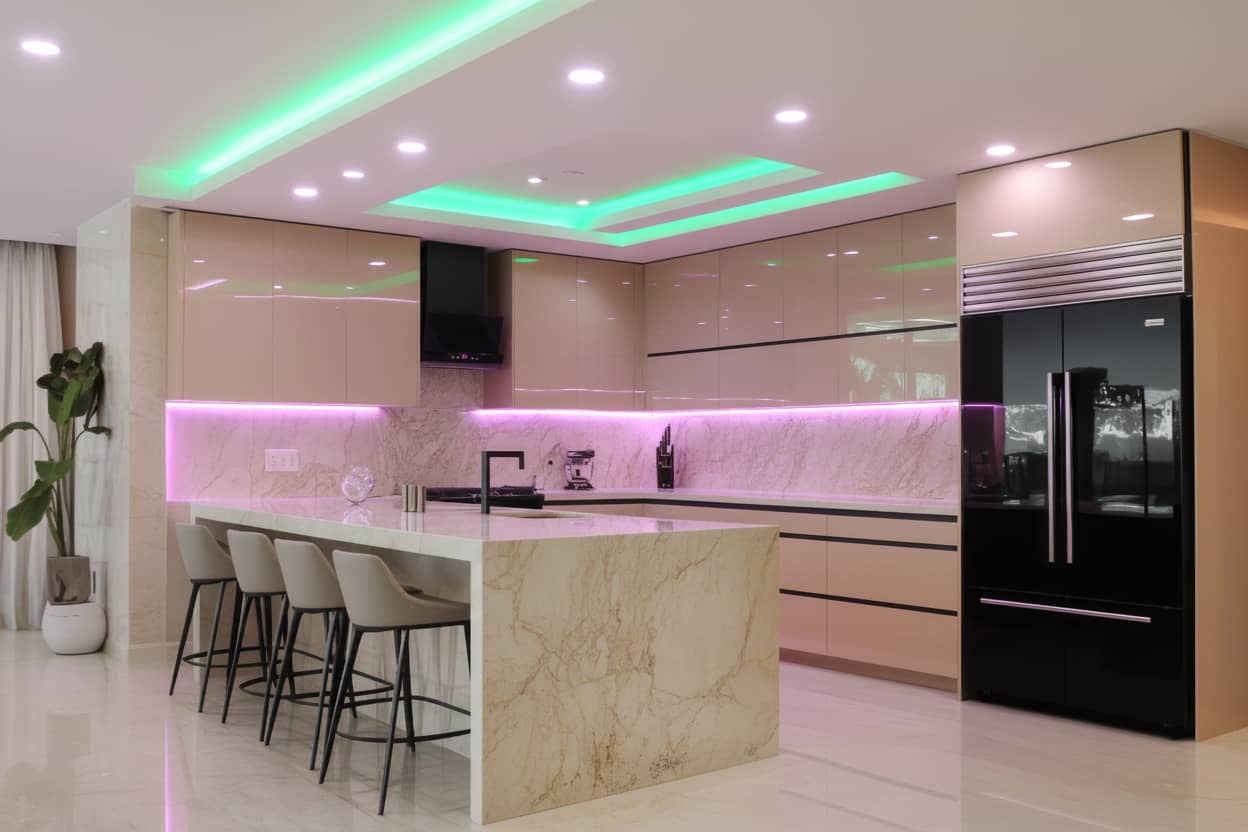
You can take this a step further by using specification-grade RGB, RGBW, or RGB+Tunable White LED strips. These lights allow you to change the light color to match themed events or special occasions.
RGB (red, green, blue) strips enable color-changing effects in venues where the atmosphere shifts significantly throughout the evening. RGBW (red, green, blue, white) strips add a dedicated white channel alongside the three color channels. Adding a white channel produces cleaner, neutral tones and makes the strip more versatile across different lighting moods and events.
Restaurants also need smooth, flicker-free dimming to get the most out of their lighting. A driver and dimmer combination that can go from near 0 to 100% output lets a dining room transition between settings without visible flicker or color shift.
Light the Back Bar and Accent Moments
A well-designed back bar is one of the most photographed spaces in any hospitality venue. LED strip lighting is central to making it work well.
Position strips beneath glass shelves to illuminate bottles and glassware from below. That creates a glow that makes the entire display appear to float. This illusion is eye-catching and also makes the back bar easier for staff to navigate.
Color temperature for back-bar shelving typically falls in the 2700K to 3000K range. That maintains consistency with the ambient warmth of the surrounding space. High CRI matters here because the colors of bottles, labels, and glassware are an important part of the bar display. A strip with low CRI output makes a carefully curated spirits selection look flat and generic.
Accent lighting behind the bar extends naturally to feature walls and architectural moments. A backlit stone panel, a lit alcove, or an RGB strip element behind a custom display provides a visual anchor beyond the shelving itself.
Dimming control is just as important at the bar as in the dining room. Strips paired with a controller that supports smooth dimming and, where needed, color adjustment, give venue staff the ability to change the feel of the bar without modifying any hardware.
Set the Tone in Hotel Lobbies
A hotel lobby is a transition space. Guests move from the outside world into the property, and that first impression shapes how they view their entire experience. Lighting that's too bright or too cool makes a lobby feel like a waiting room rather than an inviting entry.
Instead of reminding guests of a doctor's office, provide warm, layered, and intentional lighting. Let your lighting signal comfort and quality before guests have even reached the front desk.
Cove lighting is the starting point for most lobby upgrades. A warm, continuous blanket of light across the ceiling draws the eye upward and creates visual depth that overhead fixtures alone can't provide. Color temperatures in the 2700K to 3000K range are the standard for hotel lobbies and reception areas.
The same CCT (Correlated Color Temperature) should carry through to corridors, elevator lobbies, and transition areas so the experience remains consistent as guests move through the property.
Feature walls are another great way to add a layer of light to a lobby. Strip lights can backlight a stone, wood, or tile panel at the entrance, creating a focal point. This accent can quietly convey premium quality and give your guests a sense of what to expect throughout your entire property.
LED strips mounted behind the panel surface with consistent spacing and a frosted diffuser lens produce an even glow and eliminate the hot spots that direct-mounted strips can produce on reflective surfaces.
The reception desk itself is another strong candidate for under-counter or behind-panel strip lighting. A low-output strip beneath the desk fascia adds definition to the check-in zone and guides guests without drawing attention to itself.
In lobbies with significant foot traffic across a wide range of hours, tunable LED strips allow a small adjustment toward cooler output in the morning without straying from the warm-white range that defines the property's overall experience.
Specify the Full System
Specify your entire LED strip lighting system from the outset for optimal performance. The strip itself is only one component in a complete installation. The visual quality and overall result depend on every part of the system working correctly.
Every strip run requires a driver to convert AC power to the low-voltage DC used by LED strips. Drivers come in plug-in versions for simpler or consumer-grade installations and hardwired versions for professional commercial applications. Hardwired drivers should include knockouts, which are the pre-cut metal discs in the enclosure that pop out to allow conduit connections where needed.
Mounting channels are another part of the system spec. These channels protect the LED strip while also diffusing the light output. For cove lighting, backlit panels, and any application where you install the lights close to a reflective surface, mounting channels make a huge difference in the finished result.
A lens is used with the channel to eliminate the dot-and-shadow effect caused by the bare strip on nearby surfaces. The lens type controls the beam angle and softens the output. It's important to select the channel and lens together to get the desired effect.
Finally, for runs longer than 10 to 15 feet, specify 24-volt systems over 12-volt. Voltage drop across longer runs can dim the far end of a strip noticeably. 24V handles that distance significantly better than 12V, ensuring consistent light output throughout the entire strip. A common source of callbacks in commercial installations is specifying runs at 12V without accounting for the full length of the circuit.
LED strip lighting is often the element missing in many hospitality settings. It's the subtle thing that brings all the different elements of a room's design together. Choosing the right specs for your project and installing them for maximum effect can be the upgrade you're looking for in your hospitality space.
Video
Infographic
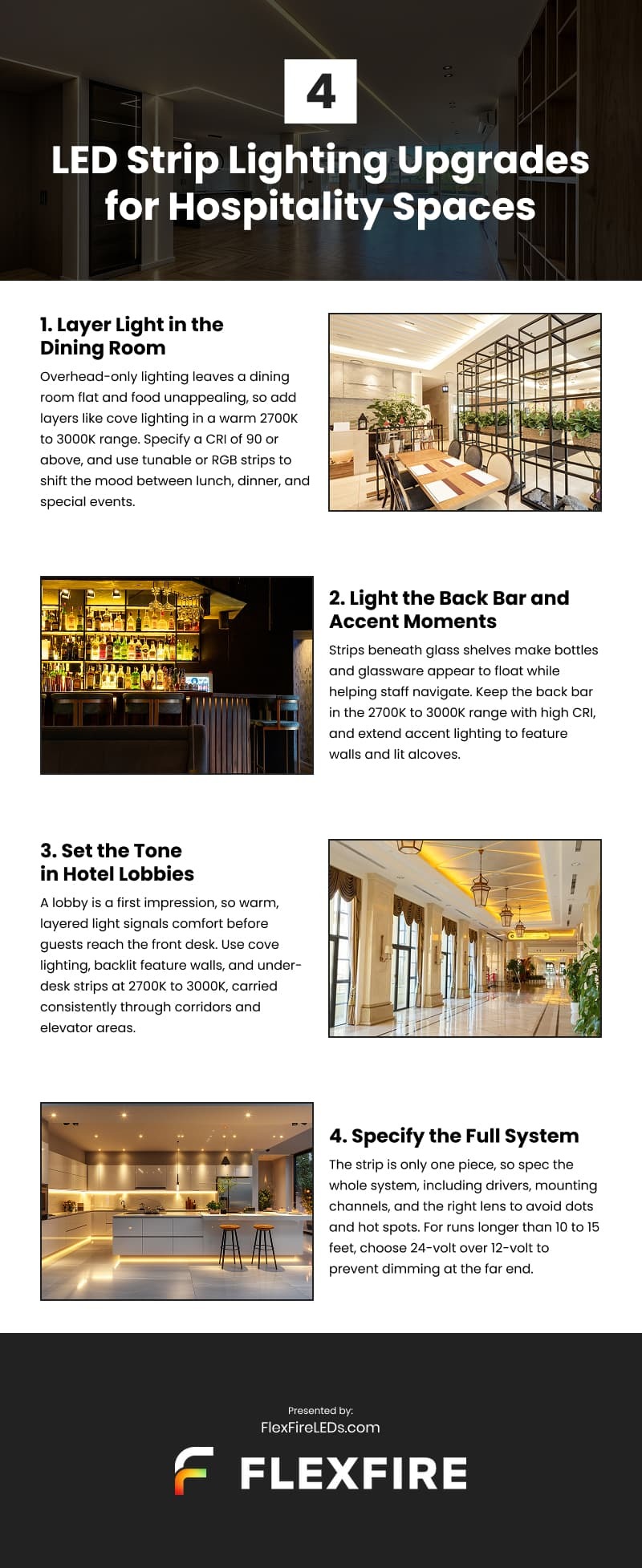
The right lighting can transform an ordinary hotel, restaurant, or lounge into a space where guests never want to leave. Take a look at the infographic below for four LED strip lighting upgrades that add warmth, style, and a true touch of luxury.