
What Size Power Supply Do I Need? Understanding LED Derating
Sizing a power supply for your LED project? Learn why the 90 or 80% rule electrical systems require is important for your home LED strip lighting.
- -Derating means operating a power supply below its maximum rated capacity.
- -Follow the manufacturer's recommended derating guideline—typically 80% for standard power supplies or 90% for premium high-efficiency models.
- -Running a power supply at or near its maximum output can increase heat, reduce efficiency, and shorten its lifespan.
- -Understanding derating curves helps you select the right power supply for your LED project, ensuring safe, reliable, and efficient operation.
Suppose you are packing for a weekend trip. You know for a fact you’ll need three outfits. Do you pack exactly three shirts, three pairs of pants, and hope that you don't spill coffee on yourself five minutes into the drive? Of course not! You pack an extra shirt. You bring a light jacket just in case it gets chilly. You give yourself some breathing room.
When it comes to powering LED strip lights, people make the mistake of packing exactly three shirts—right what they need. They look at a tape light, do some quick math, find out it needs 90 watts of power, and instinctively buy a 90-watt power supply (also called a driver).
Then, a few months later, they wonder why their lights are flickering, why the power supply box feels hot enough to fry an egg, or why the whole system kicked the bucket way before its time.
Today, we are going to discuss the golden rule of LED projects: derating (also called the 80% or 90% rule for electrical systems). We’ll look at why you should never max out your power supply, how much extra headroom you actually need, and how to calculate it all without needing a degree in electrical engineering.
What Is the Meaning of Derating?
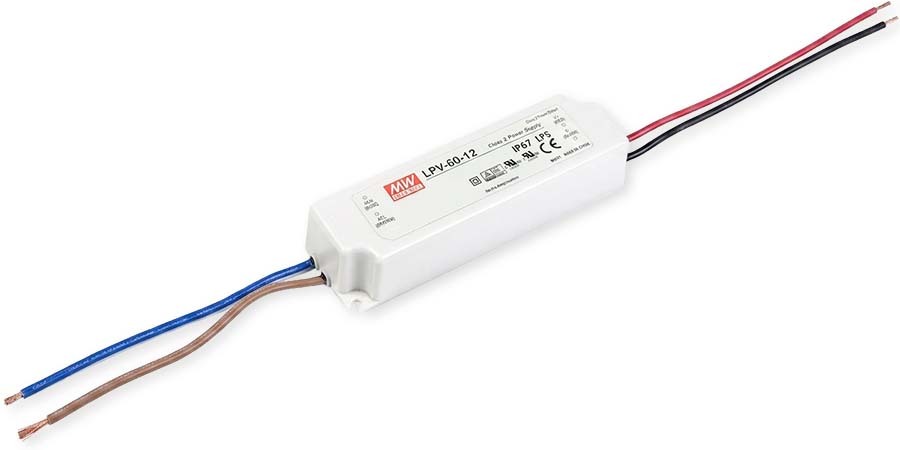
Let’s get the technical LED jargon out of the way first. Derating is simply the practice of operating an electronic device at less than its maximum rated capacity to extend its lifespan, guarantee its promised performance, and prevent failure.
When an electrical manufacturer designs a component, such as LED power supplies, it calculates the absolute maximum current it can handle under perfect laboratory conditions. This is the wattage printed on the box (60W, 100W, 150W, etc.)
However, real-world homes and offices are rarely perfect laboratory environments. Running a power supply at its absolute maximum capacity causes its internal components to operate under intense electrical stress, generating significant heat. If a power supply is continuously pushed to 100% capacity, it will degrade quickly and eventually burn out.
What Does It Mean When a Power Supply Is Derated?
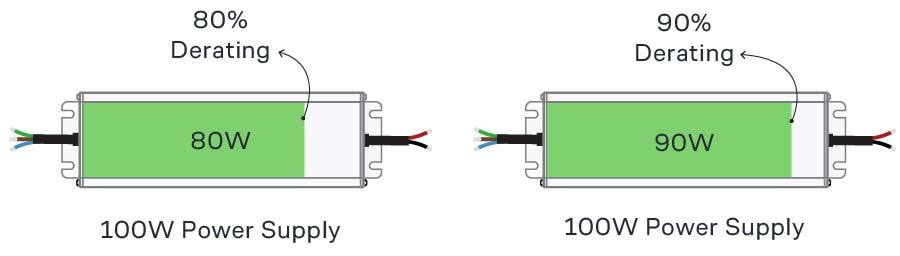
To keep things running smoothly, coolly, and safely, the lighting industry relies on certain LED driver rules or standards that you’ll need to follow based on the unit you purchase to power your light system:
- 80% Derating (Minimum): For most commercial and residential LED power supplies, the standard practice is to leave a 20% capacity reserve. In other words, your connected load should not exceed 80% of the power supply's rated output—for example, in an 80W system you’d need at least a 100W driver. This extra headroom helps accommodate real-world operating conditions and promotes long-term reliability.
- 90% Derating (For Flexfire & High-Performance Power Supplies): High-efficiency models like our Zurik™ Dimmable LED Drivers are specifically engineered to operate closer to their maximum rated output without compromising performance. That's why they only require a 10% capacity reserve, allowing you to safely load them up to 90% of their rated capacity while maintaining reliable operation—meaning your 80W system would then require an 88W driver.
What Is a Power Derating Curve?
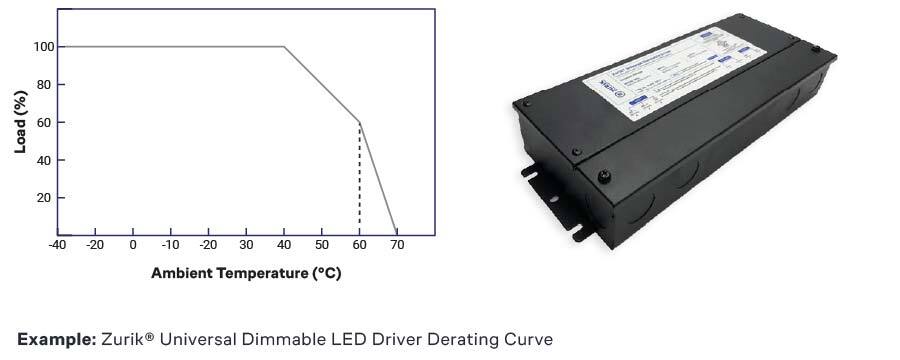
If you want to see exactly how this works in practice, manufacturers often provide a visual chart called a derating curve.
This curve is a simple graph that plots Ambient Temperature on one side and Maximum Load Capacity on the other. In a cool environment (usually up to 40 °C or 104 °F), the line stays flat at 100% capacity. But as the surrounding air temperature rises—such as inside a tight, unventilated kitchen cabinet or a warm ceiling void—the line on the graph begins to slope downward drastically.
The chart tells a stark story: As ambient heat rises, the electronics' safe operating limit declines. A 100W power supply in a hot environment might only be safely capable of delivering 60W or 70W of power. Designing your system with that 20% safety cushion (or 90% with premium systems) from the start is a manufacturer’s way of ensuring that even if your LED installation space warms up a bit, your power supply always stays safely underneath that descending performance curve.
Real-Life LED Strip Lighting & Power Sizing Example
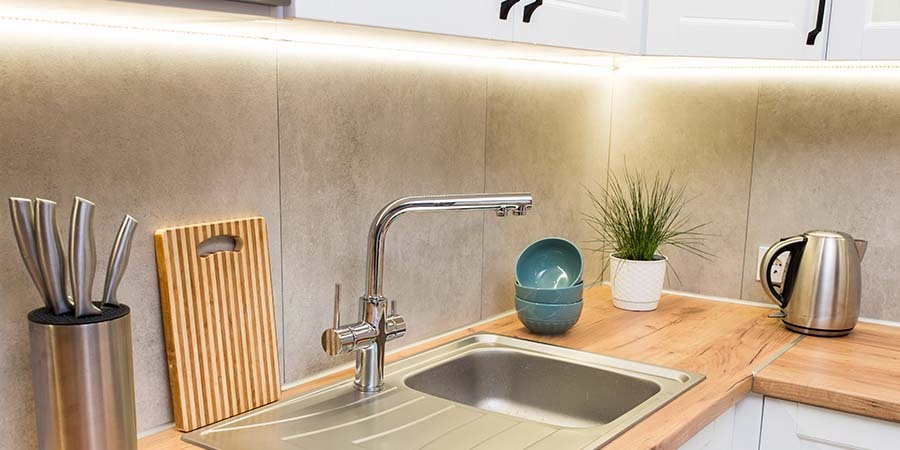
Let's look at a classic DIY scenario to see how this would play out in everyday installations. And remember, all of this applies to any room you’re lighting at home.
Meet Sarah. Sarah wants to install beautiful, natural-white LED strip lights under her kitchen cabinets to illuminate her countertops. She buys a roll of high-quality, architectural LED tape light. According to the packaging, this specific tape uses 4.5 watts per foot, and she needs to install exactly 20 feet to cover her kitchen. Sarah whips out her phone calculator:
20 feet x 4.5W/ft = 90 Watts
She goes online, finds a compact, plug-in 96W power supply, and thinks, "Perfect! 90 watts is less than 96 watts. I even have 6 watts to spare!" She hooks everything up. It looks gorgeous. She leaves the lights on all evening while cooking, hosting dinner, and cleaning up.
But after a couple of weeks, she notices a faint humming sound coming from inside the cabinet where the power supply is hidden. A few months later, she walks into the kitchen, flips the switch, and... total darkness. The power supply has given up.
What Went Wrong with Her LED Installation?
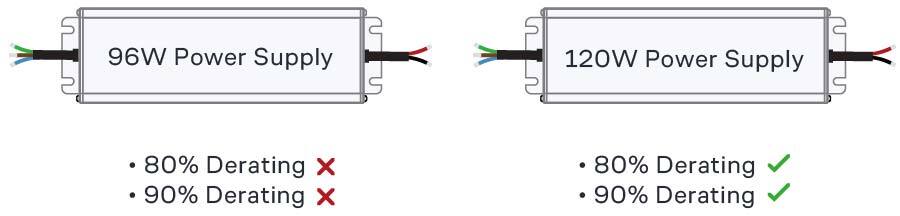
Sarah ran her power supply at around 94% capacity (90 ÷ 96 ≈ 0.94) for hours at a time. Because it was working at near-maximum capacity, the internal components generated intense heat. Since it was tucked away in a kitchen cabinet with no adequate airflow, it essentially baked itself to death.
If Sarah’s power supply were a regular one and she had applied the 80% rule, she would have looked for a driver in which 90W represents only 80% of the total capacity. To find that target, she just needs to divide her total wattage by 0.8:
90W ÷ 0.8 = 112.5 Watts
Now, if Sarah were using a premium LED power supply, the calculation would be even simpler. Since her connected load can safely use up to 90% of the power supply's rated output, she would divide her total wattage by 0.9 instead:
90W ÷ 0.9 = 100 Watts
In either scenario, following the standard wattage increments available on the market, Sarah should ultimately have chosen a 120W power supply—the nearest available model that meets or exceeds her calculated requirement. By doing so, her power supply would operate well within its intended range, run cooler and quieter, and be far more likely to deliver years of reliable performance rather than failing prematurely.
Why Is Derating Necessary? (The “Why” Behind Your LED Power Supply’s Safety Cushion)
If a manufacturer sells a 100W power supply, shouldn't it just work perfectly at 100W? It feels a little misleading, right? Well, it's not that manufacturers are lying to you—it’s just that physics and real-world environments are highly unpredictable.
The 3 Biggest Threats the Power Derating Curve Protects Against
Here are the three main reasons your power supply needs that 10 or 20% breathing room:
Heat
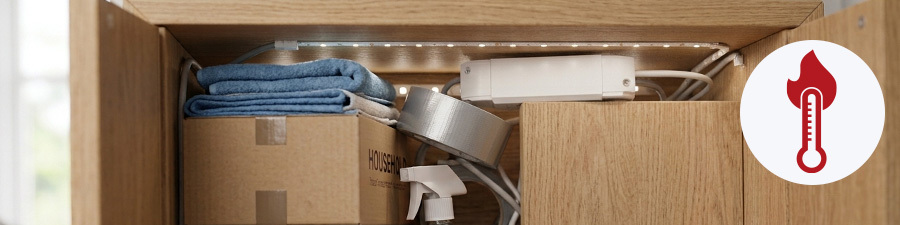
Electronic components hate heat. When a power supply converts the high-voltage alternating current (AC) from your wall into the low-voltage direct current (DC) your LEDs need, some of that energy is lost as heat.
Under normal conditions, quality power supplies are designed to operate across a wide range of ambient temperatures. However, once the ambient temperature exceeds the manufacturer's specified threshold, the device's maximum output typically needs to be reduced according to its derating curve.
Ambient temperature isn't the only factor that affects a power supply's internal temperature, though. If you cram the power supply into a tight space without airflow and load it to 100% capacity, its internal capacitors and other components will quickly begin to degrade. If the internal temperature exceeds its safe operating limit, the unit will automatically engage its emergency brake or shut down to prevent melting or a fire.
Inrush Current
When you flip a light switch, the sudden rush of electricity into the system isn't perfectly flat. For a fraction of a millisecond, the power supply experiences a massive spike in demand as it fills its internal capacitors and starts powering the LEDs. This is called inrush current. If your system is already maxed out, this microscopic morning spike can trigger the power supply's built-in overload protection, causing your lights to flash or flicker when you turn them on.
Voltage Fluctuation in Your Home

The power coming out of your home’s wall outlets isn't perfectly stable. It fluctuates based on grid demand, or when heavy appliances—like your refrigerator, air conditioner, or microwave—kick on. A sudden drop or spike in grid voltage forces your LED driver to work harder to maintain a steady output. If you haven't left a safety margin, these everyday grid hiccups can overwhelm the driver.
Is Having Too Big of a Power Supply Bad?
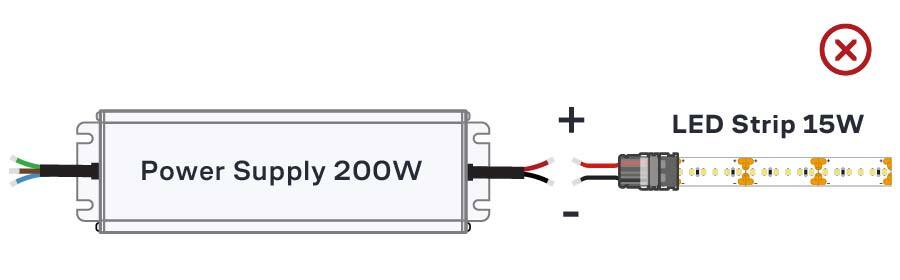
Knowing that a safety cushion is essential, a very common follow-up question is: "If a bigger safety cushion is better, can I just buy a massive 200-watt power supply for my small 30-watt project?" The short answer is yes, you can, but it's usually not the best idea for two reasons:
- Your Wallet: More powerful power supplies cost more, use thicker casings, and take up significantly more space. There’s no point in paying for a massive metal box that you have to struggle to hide behind your drywall or under a cabinet if a small, sleek 60W unit can do the job perfectly.
- Efficiency Curve: Power supplies are most efficient when loaded between 50% and 80% of their capacity. If you run a massive 200W power supply to feed a tiny 15W closet light, it will operate inefficiently, wasting a bit of extra electricity just to keep itself awake.
Checklist & LED Power Supply Calculator Tool for Your Next Lighting Project
Before you add that power supply to your shopping cart, remember the principles of derating we just learned and take a quick second to run through this checklist:
☐ Have I measured the exact length of LED strip lighting I'm actually installing?
☐ Did I calculate the total wattage based on that final length?
☐ Did I divide my total wattage by 0.8 or 0.9 based on my driver to find my safe target capacity?
☐ Is the power supply going to be installed in a place with at least a little bit of airflow so heat can escape?
☐ Did I round up to the nearest standard size rather than trying to squeeze by with a smaller unit?
One last thing to keep in mind: Derating and wattage aren't the only factors that matter when choosing the right LED power supply. You'll also need to consider your system's voltage, amperage, and any local electrical code requirements—which may call for a Class 2 power supply—to ensure a safe, reliable installation.

Fortunately, you don't have to do all the math yourself. To make power supply selection as simple as possible, we've developed our brand-new LED Power Supply Calculator: a free tool that takes the guesswork out of sizing your driver.
Just select the lighting product you're using, and in seconds the calculator recommends the ideal power supply for your setup. It automatically accounts for voltage, current, wattage, our recommended 90% derating guideline for premium power supplies, and other important considerations like Class 2 compliance, so you can choose with confidence. That means you can stop worrying about electrical calculations and focus on the fun part.
Whether you're remodeling a bedroom, refreshing your living room, or taking on your first lighting project, you don't need to be an electrician to bring it to life. The calculator will take care of the technical side—you just need to provide the one kind of power no calculator ever could: your creativity, your DIY spirit, and the excitement of lighting up the spaces where your family will create memories. Happy building!