
Light Diffusion: How to Achieve It with LED Strip Lighting
Natively diffused LED strips, aluminum channel lenses, and light diffusers are stylish ways to soften and diffuse light at home. Learn how—and why!
- -Light diffusion is the process of scattering harsh light rays to create a softer, more evenly distributed illumination in a space.
- -Diffused lighting enhances a room's ambiance, reducing glare and harsh shadows.
- -You can achieve effective light diffusion through various methods, including frosted extrusion lenses and diffused LED strip lights (like COB and cutting-edge SOB models).
Have you ever walked into a high-end luxury hotel lobby, a modern minimalist restaurant, or a thoughtfully custom-designed home or office and instantly felt a sense of refinement you can’t quite put into words? The space feels polished and visually harmonious, yet you can’t spot a single bare light bulb or harsh light fixture.
What gives these elegant environments their elevated look? Sometimes, it’s hidden lighting that doesn’t create harsh reflections on walls and adjacent surfaces. Other times, it’s integrated, subtle lighting that you can see without being blinded by it. The common thread between both approaches is diffused lighting, often achieved with LED strip lights. But what exactly does that mean?
In this guide, we will break down what light diffusion is, explain how diffused lighting works in a space, and walk through the two main ways to achieve a flawless, dot-free look with LED strips.
What Is Light Diffusion?

At its core, light diffusion is the optical process of scattering harsh, direct light rays in multiple directions as they pass through a translucent medium or reflect off a matte surface.
Rather than letting light radiate from a tiny, intense point source, diffusion expands and redistributes optical energy across a broader surface area. This process reduces contrast, broadens the beam angle, softens hard shadows, and turns raw glare into balanced, visually comfortable illumination.
What Are Some Examples of Light Diffusion?
Remember when you were a child and made a flashlight shine through your hands, a sheet of paper, or thin fabric? The light suddenly looked softer and less intense, spreading wide instead of coming through as one sharp beam. You were creating a simple, DIY form of light diffusion, probably without realizing it.
Or think of the difference between standing under direct mid-afternoon sunlight versus walking outside on a soft, overcast day. The clouds act as a massive natural diffuser: The light is everywhere, shadows melt away, and you can look around comfortably without squinting. That is light diffusion in action.
You can experience the same principle at home, usually thanks to materials such as frosted acrylic or glass, polycarbonate finishes, translucent plastic, silicone, or even lampshades. Picture your bedside table lamp: When you turn it on before bed to read or scroll on your phone, its hood keeps the bulb’s strong light from shining straight into your eyes and disturbing your sleepiness. That’s diffusion applied to illumination, and we call it diffused lighting.
What Is Diffused Lighting?
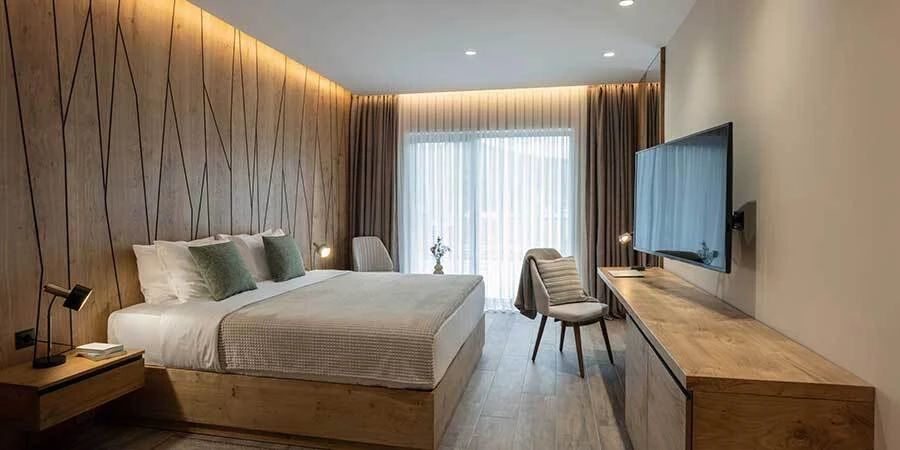
If light diffusion is the physical process of scattering light rays, diffused lighting is the visual environment that process creates—the way light is provided and arranged to illuminate a space like your bedroom or living room. It describes the overall ambiance of a space where illumination feels balanced, gentle, and evenly distributed rather than harsh or aggressive.
A common misconception in architectural design is that diffused light must always be hidden or bounced off a surface. In reality, light diffusion is simply about how the light behaves at its source or surface, regardless of whether the fixture is pointing straight at you or away from you.
To see how this plays out in real spaces, it helps to understand the four possible combinations of direct/indirect and diffused/non-diffused light:
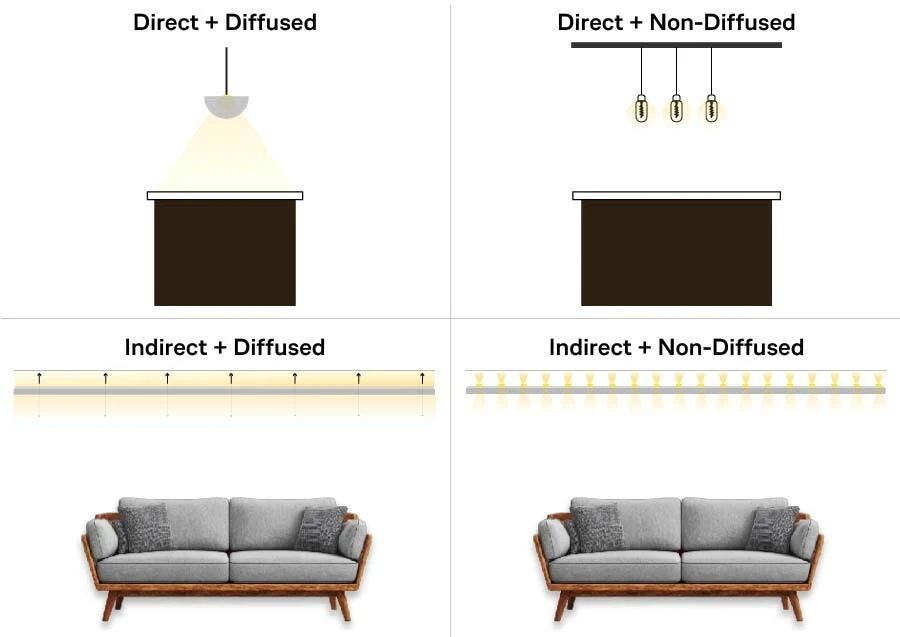
- Direct + Diffused: A frosted glass globe pendant hanging over a kitchen island, or an under-cabinet LED strip in a frosted aluminum channel mounted right over a kitchen counter. The fixture points straight at your work surface, but the lens distributes the rays so you get bright, direct light without eye strain or hotspots.
- Direct + Non-Diffused: A bare, decorative, clear-filament Edison bulb hanging above an industrial-style bar, or a sharp halogen spotlight focused on a model during a photoshoot. The light fires straight out with zero filter, creating crisp, hard-edged shadows and intense visual punch (and often uncomfortable glare).
- Indirect + Diffused: An LED strip tucked inside a drop-ceiling cove—passing through a diffuser lens first—and then bouncing off a matte white ceiling. The light is softened twice, creating a seamless, cloud-like ambient glow throughout the room.
- Indirect + Non-Diffused: A bare, high-output LED strip hidden behind a headboard or under a floating bathroom vanity without a diffuser channel. The source is hidden from view, but because the individual mini-bulbs aren’t diffused before hitting the wall or floor, distracting dotted hotspots may appear—especially on glossy surfaces—unless the strip has a very high density (meaning, short spacing between each tiny LED).
How to Diffuse Light at Home?
Recognizing these distinctions makes it much easier to decide when and where to diffuse light across the three core layers of lighting design in your spaces:
Should I Diffuse Ambient Lighting? (Always)
Ambient light is your background layer—the general illumination that fills a room, the one you call “the main light”—and it should always be diffused. Undiffused ambient light causes glare, visual fatigue, and harsh visual breaks.
That’s why ceiling cove lighting, perimeter linear lighting, or main hallway flush-mounts should always be diffused to keep the room feeling spacious and inviting.
Should I Diffuse Task Lighting? (Sometimes)
Task lighting implies strong visibility for activities like chopping vegetables or reading in bed or in your favorite nook, but raw points of light reflect painfully off glossy countertops and digital screens.
Under-cabinet lighting in a kitchen with polished granite or quartz counters—as well as decorative tile backsplashes—should be diffused to prevent harsh LED reflections. However, a focused desk lamp with a deep shade can keep the beam unfiltered and tight to the page, covering your full book instead of washing over the desk.
Should I Diffuse Accent Lighting? (Mix & Match)
Accent lighting draws the eye to specific features, textures, or artwork. Whether you diffuse it depends entirely on the material you are highlighting or the type of installation.
If you are grazing a textured stone wall or brick feature, a diffused LED strip creates a smooth, elegant architectural wash. But if you are highlighting specific items in a wooden display cabinet, floating shelves, or metallic sculpture—a collection of action figures or mineral specimens, for example—non-diffused point-source lighting (for example, puck lights) adds desirable sparkle and dramatic contrast.
How to Make LED Strips Diffused?
To achieve seamless, diffused lighting with flexible tape lights, your main goal is to eliminate hotspots: the spotlight effect caused by individual surface-mounted diodes spaced along the LED strip’s metal ribbon (also known as a printed circuit board). Depending on your space, budget, materials, installation depth, and environmental requirements, there are two basic solutions available:
How to Use Light Diffusers & Aluminum Channels?
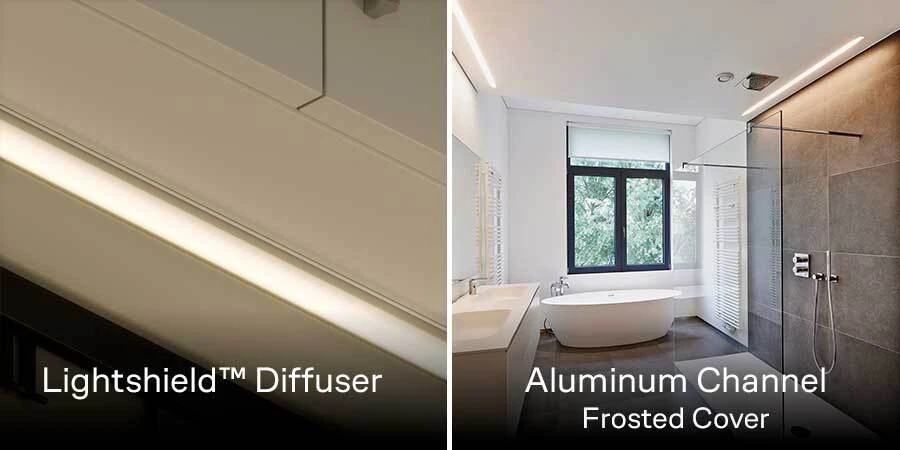
The most traditional and versatile way to diffuse linear lighting is by pairing regular LED strips with a frosted light diffuser or an aluminum profile with a diffuser lens. These are popular in custom builds, and the result could be a beautiful, grooved coffee table with integrated stripes of light, geometric pendant patterns with a diffused glow, and many other specific designs.
A standalone diffuser is essentially a PVC or plastic, half-domed cover designed to soften and scatter the LED strip it sits on. In a channel-and-lens setup, the LED strip is adhered inside a metal channel, while a polycarbonate or acrylic lens—typically frosted or matte for diffusion, or clear if you just want protection and enclosure—snaps over the top.
This system achieves diffusion through two processes:
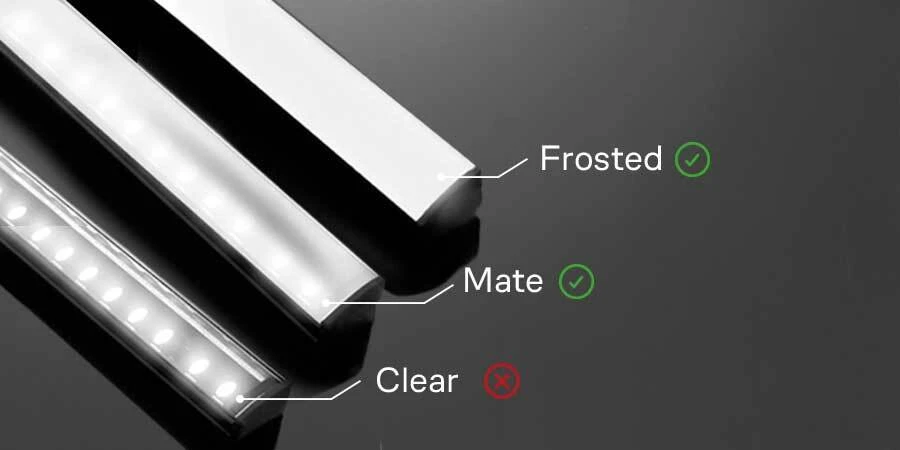
- Optical Scattering: The frosted lens absorbs direct light points and refracts the light rays evenly across its surface.
- Depth & Spacing: The depth of the aluminum channel creates physical space between the LEDs and the diffuser lens, allowing light beams from adjacent chips to overlap before exiting the fixture.
The biggest advantage of extrusions is their versatility. Available in surface-mount, recessed, corner, and trimless mud-in profiles, they can accommodate nearly any standard LED strip, giving you the freedom to adapt your lighting to virtually any space or application. Their rigid aluminum housing also helps dissipate heat, extend LED lifespan, and protect the strip from physical damage and dust.
The downside is added cost and installation time. High-quality aluminum profiles, end caps, mounting clips, and specialized lenses can significantly increase the per-foot cost, while installation may require precise measuring, cutting, and additional mounting hardware compared to plug-and-play or already diffused solutions.
What Are Diffused LED Strip Lights?
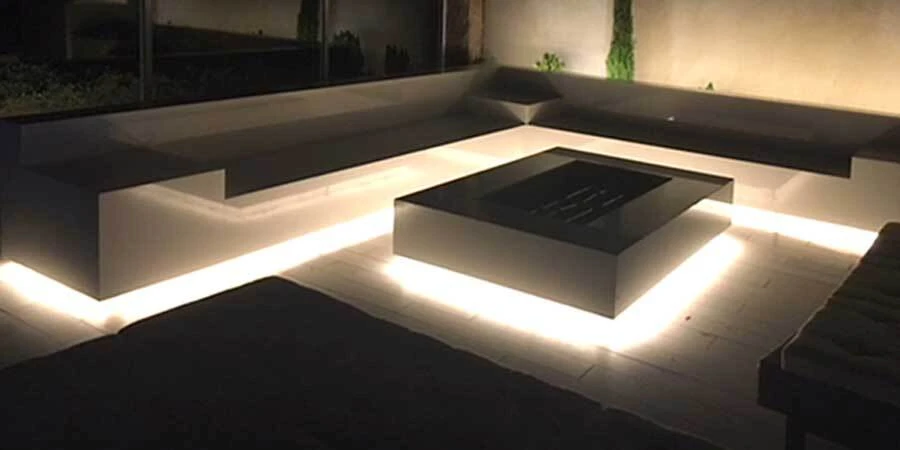
While extrusions and secondary lenses are a reliable choice, recent advances in LED manufacturing now make built-in, continuous light diffusion possible without separate aluminum channels.
Diffused LED strip lights are linear solutions engineered with integrated light scattering directly at the product level. Instead of installing a raw tape inside a metal housing and snapping on a cover, these strips deliver a smooth, dot-free ribbon of light right off the reel.
This integrated diffusion is typically achieved by coating, encapsulating, or embedding high-density mini LED bulbs within a continuous layer of light-distributing translucent material, such as optical-grade silicone or phosphor housing. The light spreads instantly at the strip surface, so these self-diffusing spools offer a super-low profile and multiple uses.
Because many of these integrated models are fully encapsulated, they're easy to clean and often feature rugged IP67 or IP68 protection. This means you can find high-performance outdoor diffused LED strip lights built to handle wet locations, patios, and harsh environments without compromising their smooth, dot-less light and appearance.
Depending on how the LEDs and diffusion materials are engineered on the printed circuit board, integrated diffused strips usually fall into two cutting-edge categories:
What Is a COB LED Strip & When Should I Use It?
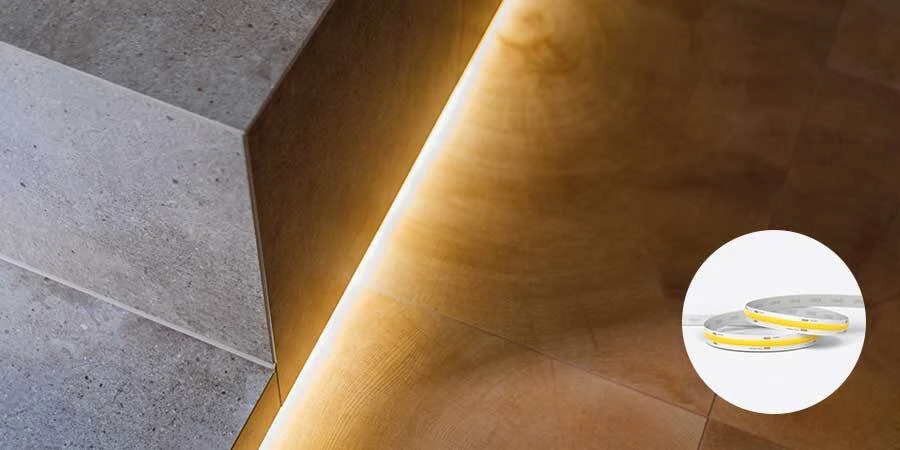
COB (Chip-on-Board) strip lights achieve native diffusion by rethinking how light-emitting diodes are mounted. Instead of spacing individual, packaged mini-bulbs several millimeters apart, COB strips place hundreds of tiny, bare LED chips directly onto the flexible board in an extremely tight row.
This dense line of micro-diodes is then covered with a continuous strip of yellow phosphor-infused silicone. When turned on, that entire phosphor strip glows evenly, completely erasing visible hot spots and dots. COB strips deliver flawless, uninterrupted lines of light, providing a clean beam even when mirrored in high-gloss stone, polished tile, or glass countertops.
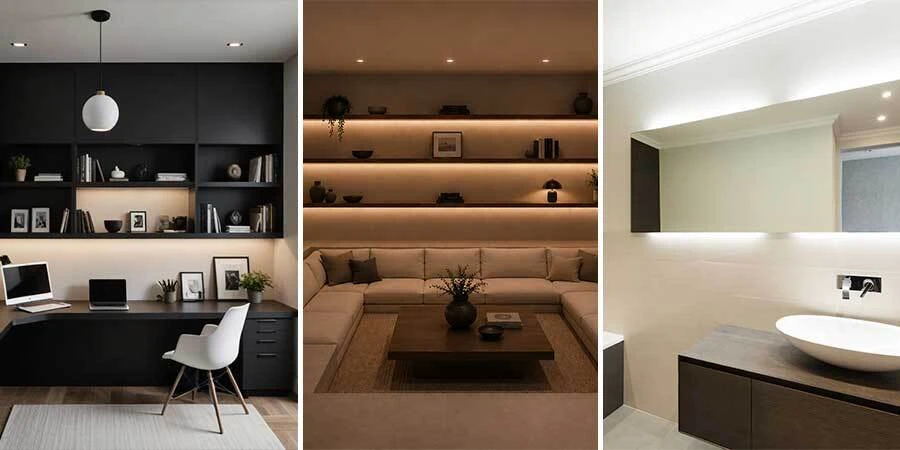
Some Home Applications for COB Strips:
- Under-Cabinet Desk Lighting (Over Barnished Wood): Because COB strips eliminate LED spots when illuminated, they are ideal under home office cabinets mounted over polished walnut, mahogany, or oak. Instead of harsh, dotted reflections on your work surface or computer screen, you get a clean, continuous reflection.
- Low-Clearance Open Shelving & Bookcases: COB strips can be recessed into thin wood shelves or mounted under shallow floating living room mantels without requiring bulky aluminum channels to hide the dots.
- Bathroom Vanity Toe-Kicks & Mirrors: When mounted along bathroom toe-kicks or behind floating mirrors, water-resistant, IP65 COB strips cast a smooth, even glow onto reflective marble or porcelain floor tiles without revealing individual pinpoints of light.
What Is a SOB LED Strip & When Should I Use It?
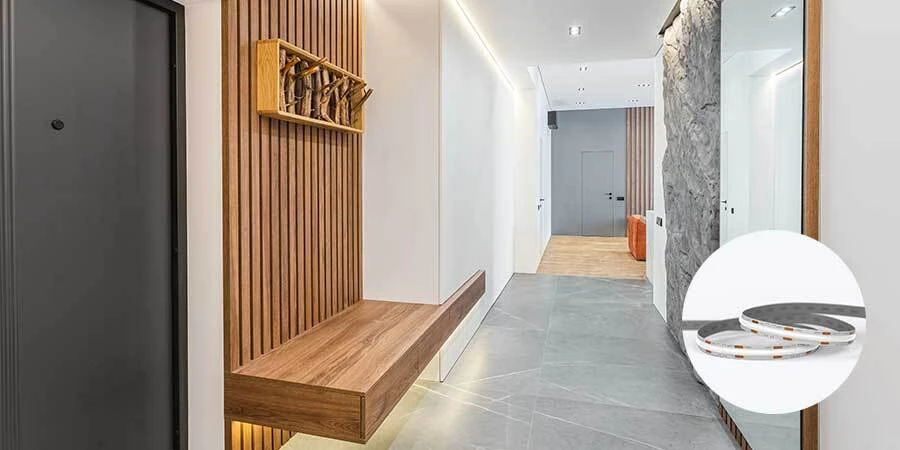
While COB technology brought dot-free lighting into tight spaces, it can be fragile during handling and installation. The latest evolution in seamless linear illumination is SOB (SMD-on-Board) LED Strip Lights: a smarter design built to deliver that same unbroken glow with extra durability and better color matching.
SOB technology combines individual protected LEDs with a smooth, continuous top coating:
- Built for Durability: COB strips place bare light chips on the PCB under a single gel layer, making them easy to damage if twisted or bent roughly during setup. SOB strips add a second layer of protection by keeping each LED safely encased inside its own tiny housing before covering the entire strip in a protective silicone layer. This dual-layer build handles installation stress without breaking or causing dead spots.
- Consistent Color, Every Time: Because each LED is tested and color-matched individually before being built into the strip, SOB strips deliver exceptionally consistent light tone from end to end—and across different home projects—so your room or adjacent rooms never have mismatched warm or cool spots.
- Clean Look, Both On & Off: With traditional COB strips, you see a bright yellow phosphor line running down the strip even when the light is turned off. SOB strips keep the color mix inside the diodes, so the top surface looks clean and white when powered off.
For spaces that see occasional splashes or higher ambient moisture—such as kitchen splash zones, bathroom shower nooks, or covered outdoor patios—you can also choose an IP65 water-resistant SOB LED strip for reliable protection against humidity, debris, and dust.
Because SOB strips have native, edge-to-edge diffusion, pairing them with secondary aluminum channels is optional. However, they remain fully compatible with extrusions if your project requires extra physical mounting protection, trimless mud-in installation, or improved thermal management in areas where heat could build up.
Some Home Applications for SOB Strips:
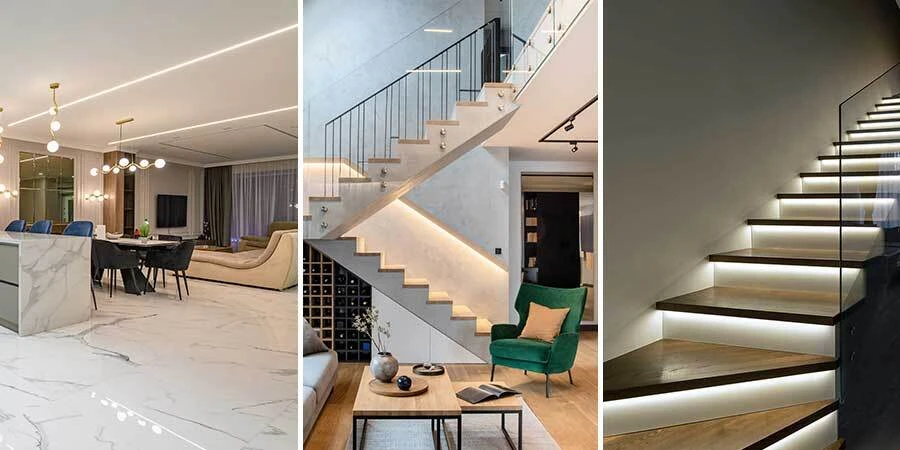
- Hallway & Living Room Ceiling Perimeter Lighting: Living room perimeter coves often require multi-reel runs of light that extend into hallways, transitions between rooms, and other common areas of your home. SOB strips are ideal for these applications because strict color matching helps maintain a consistent appearance from one space to the next, while handling the stress of being pulled through long ceiling channels.
- Exposed Linear Accent Lighting (Valances & Open Trims): Since SOB strips feature a clean white top layer instead of a bright yellow phosphor line, they are ideal for visible or semi-visible installations—like open valances, bedroom headboards, or closet framing—where the strip remains clean and subtle even when turned off.
- High-Traffic Staircase Handrail Lighting: Stairway installations experience subtle vibrations and some bending during setup. The dual-layer protection of SOB strips makes them resilient against installation strain while providing crisp, continuous safety lighting along handrails.
Try Flexfire: Experts at Diffused LED Strip Lighting
Have a project in mind that calls for soft, subtle, and calming light? Maybe lighting along the bottom of a bathtub that won’t create harsh reflections on the tile floor, or an LED strip designed to fit into the grooves of an accent wall in your entryway?
Whatever your project, Flexfire specializes in scattered, spread-out lighting, with multiple strip lighting lines—with regular and SOB diffusion—and specialized aluminum channels to help you achieve the look you’re after. And with 10+ years of experience creating beautifully illuminated spaces across the country, we’ve learned a thing or two about getting it right.
We don’t just diffuse lighting; we diffuse knowledge too! Reach out to our team and let us help you find the right solution for your project.