

COB LED Strip vs. SOB LED Strip: What’s the Difference?
COB LED strips offer smooth, diffused lighting, but with drawbacks. Discover how SOB LED strips compare and where they may offer advantages.
- -The evolution of linear lighting highlights the push to eliminate visible dots while balancing appearance and structural reliability.
- -While COB technology solved the hotspot and additional-accessories problem, it introduced trade-offs like structural fragility and an unlit yellow tint.
- -SMD-on-Board (SOB) represents the next step forward, offering a superior balance of durability, clean unlit looks, and high-quality diffusion.
For years, lighting designers and contractors have faced a compromise when seeking a truly spotless, dot-free line of light. Traditional Surface-Mounted Diode (SMD) strips typically require additional accessories to eliminate visible hot spots. While these setups are reliable and offer other perks, they can also increase project costs and limit installation options in tight spaces.
Then Chip-on-Board (COB) technology appeared, offering built-in diffusion for a continuous line of light right out of the box. However, COB introduced its own aesthetic and structural trade-offs, most notably a prominent yellow hue when powered off and fragile micro-wire bonds.
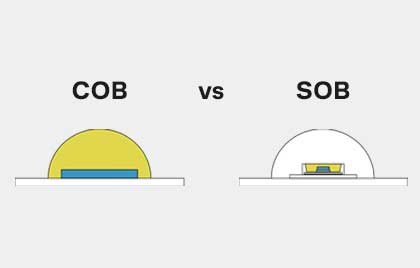
This has led to a more practical, modern approach: SMD-on-Board (SOB) technology. Designed as a high-performance alternative to traditional COB, SOB addresses some of the visual and mechanical limitations associated with COB technology. Let’s break down what SMD is, how SOB builds on it, and how it stacks up against COB LED strips.
What Does Surface Mount Diode (SMD) Mean?

To understand where modern linear lighting is heading, we first have to look at the baseline: traditional SMD. That’s the construction used in most of our standard Flexfire LED strip lights.
Think of a traditional SMD like a tiny, individual picture frame: each LED chip (the micro-bulbs that line your strip and that we typically call “individual LEDs”) is safely placed inside a reflective bracket, encapsulated with phosphor resin, and soldered directly to a copper ribbon, also called the Printed Circuit Board (PCB).
When using a blue LED chip, standard yellow phosphor acts like a color filter, absorbing a portion of the blue light and converting it into daylight and cool white. Red and green phosphors can be blended in to achieve warmer white light. And by varying the phosphor mixture, we can tune SMDs to different white correlated color temperatures.
While highly reliable, traditional SMD strips space these individual “frames” apart along the board, so they can produce visible, reflected dots known as “hot spots.” Higher-density SMD strips pack more individual LEDs into a given length—making them brighter by nature, reducing the spacing between each “frame,” and creating a brighter, more uniform appearance.
However, even higher-density SMD strips can still show individual LEDs, particularly when installed close to the viewing surface. That’s why SMD strips have historically been paired with deep aluminum channels and frosted diffusers to create a truly seamless line of light.
What Is Chip on Board?
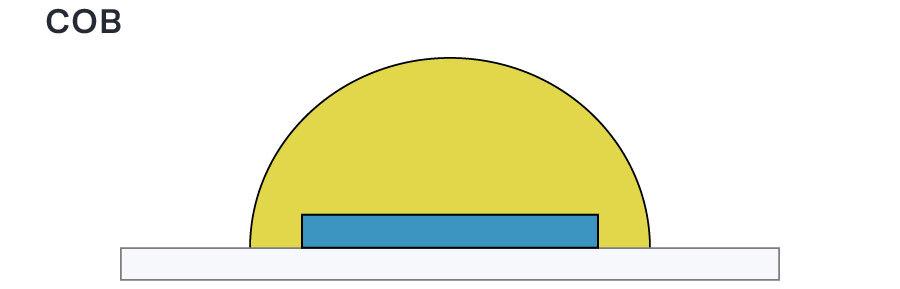
To eliminate those visible SMD dots, the industry introduced a then-cutting-edge way of achieving LED light diffusion in lighting projects, without additional hardware, right from the tape itself. That's when Chip-on-Board (COB) technology was born.
COB strips mount bare, microscopic LED dies directly onto the PCB, encapsulating the entire run in a continuous ribbon of phosphor-infused silicone layer.
On the one hand, the phosphors are mixed with the silicone, making the strip's white hue possible. It acts as a color-converting chemical translator: it absorbs a portion of that harsh blue light and shifts it into longer wavelengths (like green, yellow, or red). When the remaining blue light blends naturally with these newly emitted wavelengths, the human eye perceives the combination as clean white light.
On the other hand, it acts as a light diffuser by scattering and spreading the intense points of light from the raw dies across the continuous silicone blend, turning individual micro-chips into a uniform line of illumination.
How Does a Chip on Board LED Strip Differ from Traditional SMD LED?
To truly understand how COB revamped linear lighting with its native diffusion, it helps to look at how its physical construction diverges completely from traditional SMD architecture:
- In a traditional SMD strip, individual diodes are pre-packaged components: Each chip is housed inside its own reflective plastic frame, connected internally with tiny gold wire, sealed with phosphor resin, and then soldered as a complete unit onto the board.
- In contrast, COB strips strip away these individual housings entirely. Instead of mounting pre-packaged units, manufacturers place the raw, unpackaged LED chips straight onto the circuit board and blanket the entire line under a single continuous layer of phosphor-infused silicone.
While this structural shift successfully eliminates the physical spacing gaps that can cause SMD hot spots, it also removes the individual protective walls around each diode, leaving the chips exposed to the physical strain of bending and twisting during installation. This is just one of a few real-world installation complaints associated with COB technology:
Is a COB LED Strip Too Fragile for Complex Installations?
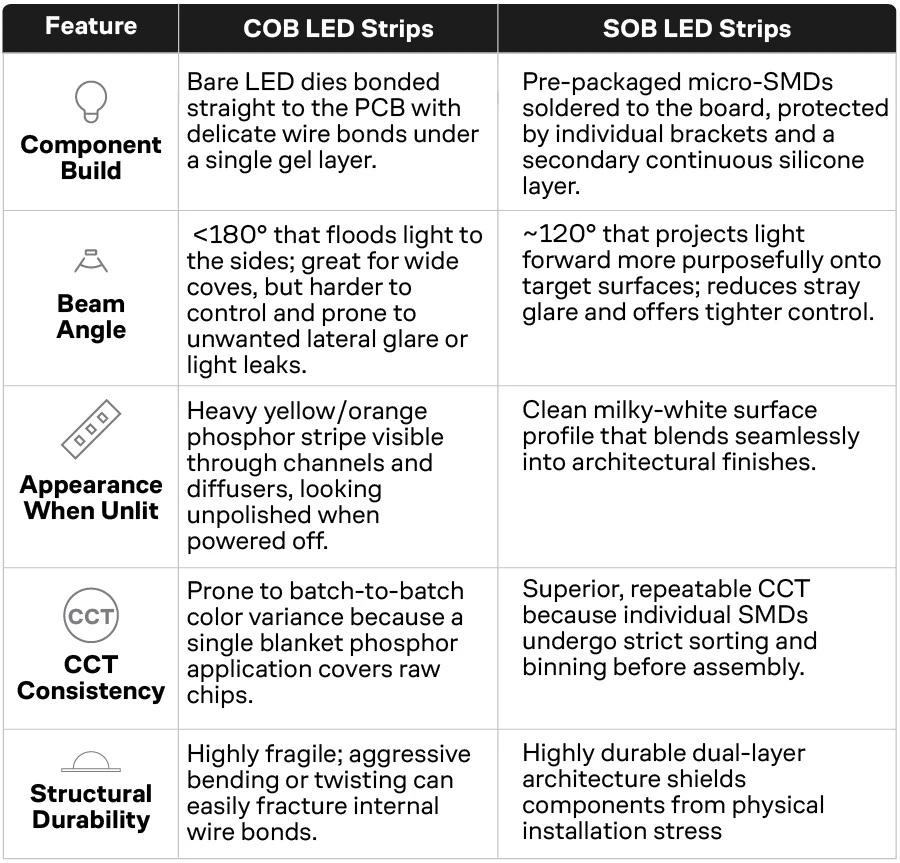
Yes. Think of COB's bare LED chips like miniature glass ornaments held together by hair-thin spiderwebs (the tiny gold wire bonds) with no hard structural shell protecting them. Bending or twisting the strip too aggressively during installation acts like putting sudden torque on a house of cards, easily fracturing these fragile micro-wire bonds and causing dead sections.
Some of its other, more important drawbacks involve the final color results in your projects.
Does COB LED Look Yellowish When Turned Off?
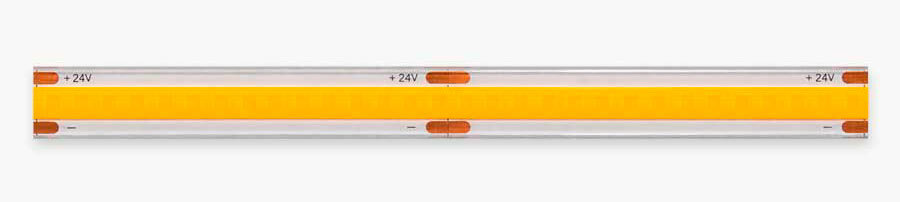
Imagine a stained-glass window panel or a strip of amber-tinted resin: Because the phosphor mix is blended directly into the external silicone gel that diffuses the LEDs, COB strips feature a solid, yellowish-orange stripe down their entire length.
In direct-view applications or architectural channels, this yellow tint is clearly visible even when the lights are off, creating a jarring, unpolished aesthetic against clean walls or ceilings.
Do COB LED Strip Lights Suffer from Color Inconsistencies?
Because a single continuous layer of phosphor-infused silicone blankets thousands of raw chips at once, it is like pouring a uniform wash over a mixed canvas—manufacturers cannot easily adjust for microscopic variances in the base LED chips' blue wavelengths, leading to noticeable CCT shifts between production batches. In practice, this can become noticeable when multiple runs need to work together across a larger space or project.
In a warehouse, for example, a long installation may require multiple reels or production batches, and even a subtle CCT difference can make one section of the lighting appear slightly warmer or cooler than the next.
The same issue can show up in residential projects, such as when lighting transitions from a dining area to a living room, or when a client adds to an existing installation months or years later, and the newer strip comes from a different production batch.
SOB LED Strips: The Next Big Thing in Light Diffusion
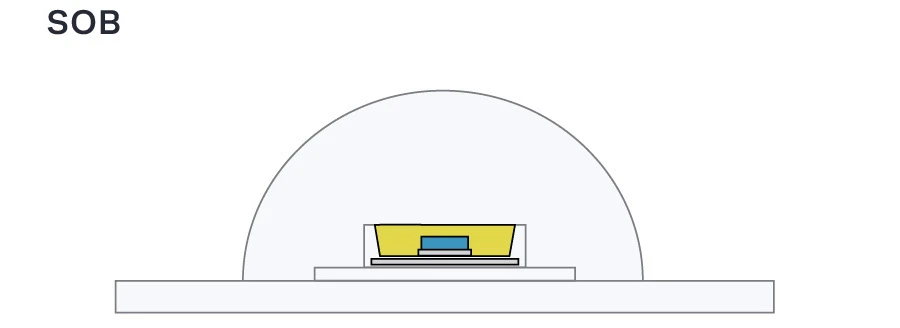
To solve COB's structural weaknesses and unlit yellow appearance while keeping a dot-free glow, engineers developed SOB (SMD-on-Board or Segment-on-Board) LED strips. Instead of spacing standard diodes farther apart or using bare, unpackaged chips, SOB uses ultra-small surface-mount diodes (SMDs) mounted densely on the printed circuit board and under a silicone ribbon.
The result is a more durable LED strip that delivers a completely smooth, uninterrupted line of light without separate diffusers or extrusion covers.
To summarize, you could say, informally, that SOB blends some of the benefits of both COB and traditional SMD in a high-performance build that provides:
- Pre-Packaged Protection: Unlike COB's naked chips, an SOB diode keeps the reliable structure of traditional SMD, acting like a miniature component in its own secure enclosure—housed inside a small reflective frame, connected via a gold wire, and then soldered to the circuit board.
- Separated Phosphors & Diffusion: The phosphor mix is integrated directly inside each individual SMD package during manufacturing. Because the phosphors are self-contained within each housing, they act like an independent capsule, allowing the continuous silicone layer applied over the top to remain completely clear or milky-white.
- Individually Applied Phosphors: Each SMD receives its phosphor coating separately during manufacturing rather than spread over the entire strip at once. This component-level approach helps maintain tight CCT tolerances and minimizes color variation between production runs, resulting in more consistent, uniform light output from one production cycle to the next.
How Are SOB LED Strip Lights Similar to COB LED?
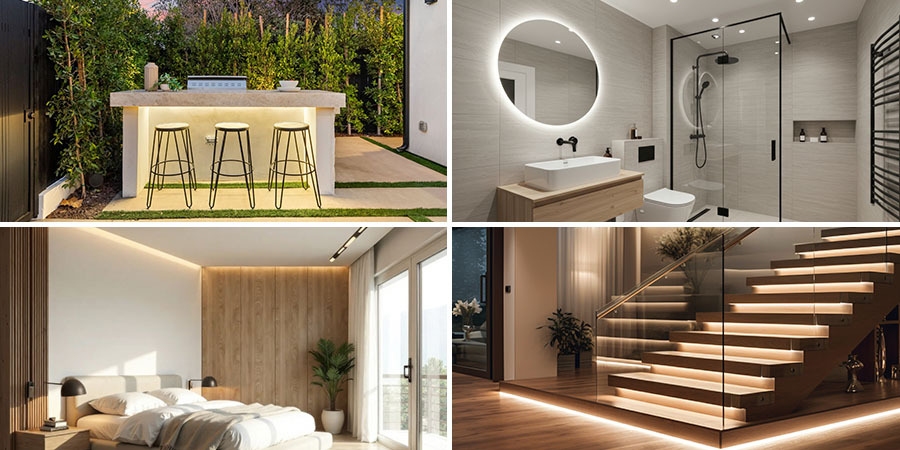
Because both SOB and COB strips are natively diffused linear tape lights, they produce spread-out light and share many of the same high-end architectural applications.
Overall, they cover indirect lighting uses where reflected light could create hotspots—on backsplashes, glass, tile, etc.—or direct applications where glare must be avoided at all costs. Among others, these include:
- Architectural perimeter and cove lighting
- Under-cabinet lighting in kitchens and bathrooms
- Glass and shiny wood retail displays and shelves
- Glass display cabinets
- Grooved accent walls and recessed setups
How Is a SOB LED Strip Different from a COB LED Strip?
Even when their intended destinations are identical, their underlying construction creates distinct performance qualities that can tip the scales one way or the other. When choosing between COB and SOB LED strips, success lies in the small technical details and operational performance rather than where the strips are installed:
Ready to Tackle Your Next Diffused LED Strip Lighting Project?
It wouldn’t be accurate to say that one type of LED diffusion is universally better than another. SMD strips paired with aluminum profiles, for example, offer benefits beyond diffusion, including easier cleaning and better heat management. Some COB diffused strips may cost less or offer a wider beam angle, while SOB brings the additional benefits we’ve already covered. Ultimately, the right choice depends on each project's specific needs.
For now, based on 15 years of experience helping professionals create beautifully diffused lighting for projects across the country, we’ve chosen to offer a premium SOB option that delivers these added benefits without an exorbitant price tag. It's ideal if your project requires extra protection during installation, a neutral appearance without the yellow tint that can be especially important for discerning clients or color-sensitive finishes, and greater consistency when lighting multiple rooms in the same home or completing a project in phases over time.
We invite you to discover Verity™: our new SOB diffused LED strip light, available in both an indoor version and a version designed for damp locations. And if you’re not sure which diffused LED strip solution is right for your project, contact our LED experts for guidance today!